Is there an AI image generator with no restrictions?
Not in the literal sense, and any company saying otherwise is selling you a headline. Even articles ranking for this keyword admit it: one roundup titled for 2026 concedes that "completely limitless free usage is rare", and one product page targeting the phrase states outright, "This is not an unrestricted generator." Every hosted service has legal obligations, and most have far more rules than the law requires.
So the useful question isn't "which AI image generator has no restrictions?" but "which one restricts the things I actually want to make?" When people say "no restrictions", they usually mean one of four different things:
| What the page claims | What it often means in practice | What to check |
|---|---|---|
| "No restrictions" | No sign-up required | Whether dark or violent prompts still get blocked |
| "Unlimited" | Slow queue, daily caps or low resolution | Real caps per day or month |
| "Uncensored" | Fewer content filters on some models | A written list of what is still refused |
| "Free" | Credits, ads or a public gallery of your images | Whether your creations are private |
iCommon marketing claims around unrestricted AI image generators
Why AI image generators refuse your prompts
A refusal can come from four different layers, and knowing which one hit you explains a lot of the weirdness:
- Prompt screening. Before anything is drawn, your text is checked against blocklists and classifiers. Leonardo's developer docs, for example, say NSFW generation is blocked by default and a flagged prompt returns an error labeled "content moderation filter".
- Model training. Some models were never taught to draw certain things, or were tuned away from them. No rewording fixes that: the skill just isn't there.
- Output checks. After the image is generated, a second classifier can inspect it. A gore-like texture or a face that resembles a celebrity can get a finished image blocked even when the prompt passed.
- Account enforcement. Some services track repeated violations. Midjourney's community guidelines (checked October 2026) mention warnings, time-outs and blocks, and note that an input not being auto-blocked doesn't mean it's allowed.
On top of the layers, there are style rules. Midjourney asks users to avoid gore, including blood and detached body parts, and anything "visually shocking or disturbing". For horror, war and crime art, that rules out a lot of perfectly legitimate work.
The false positives: innocent prompts that get blocked
Filters read words, not intent. Users on the OpenAI developer forum reported that a dark forest with a red-eyed bear was generated, while a "scary forest with a scary bear" was refused. Here are the kinds of everyday wording that commonly trip keyword-based filters:
| Innocent prompt | Word that can trip a filter | Why |
|---|---|---|
| Fashion photoshoot on a rooftop | shoot | Overlaps with weapons vocabulary |
| A bloody good British breakfast | bloody | Read as gore |
| Funeral scene for a period drama | corpse, coffin | Death imagery flagged as disturbing |
| Surgeon mid-operation, medical illustration | blood, scalpel, wound | Read as graphic violence |
| Haunted house book cover | scary, terrifying | Mood words flagged as shocking |
iIllustrative examples. Filters differ by tool and change over time.
If a synonym gets through, you hit a keyword list, not a real rule. That's why results feel random: the filter isn't judging your image, it's matching your words.
AI image generator no restrictions: what one can honestly offer
Strip away the marketing and a genuinely unrestricted AI image generator, in the honest sense, offers three things: it understands context, it allows dark and violent fiction, and it publishes the few things it won't do. That's the standard we hold ourselves to.
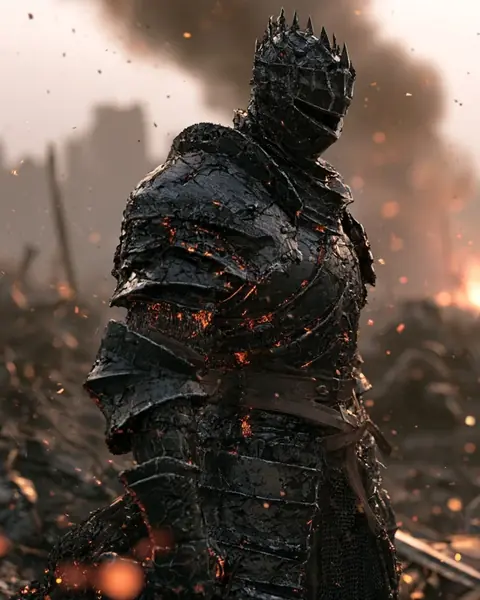
- 01Dark subjects allowed.Battle aftermath, crime scenes, monsters, body horror, disasters and decay.
- 02Context over keywords."Bloody" in a battle painting isn't treated like a threat.
- 03No sermon.You get an image, not a paragraph about why you shouldn't have asked.
- 04A short, public list of refusals.You know the rules before you pay.
The same logic applies to text. If you're wondering whether a chatbot can work this way too, see is there an AI with no restrictions. For a style-by-style tour of what our image tool does best, see the uncensored AI image generator page.
Prompts that work here and often fail elsewhere
These are written in plain language, without tricks or misspellings. If a prompt only works when you disguise it, the tool isn't really letting you make it.
Want to write the story that goes with them? The same app includes an uncensored AI chat that handles dark fiction without flinching.
Free AI image generator with no restrictions? Read this first
Free options exist. Perchance's text-to-image page, for example, describes itself as completely free with no sign-up (checked October 2026). Open models you run on your own graphics card cost nothing beyond the hardware and electricity. But free hosted tools have to cover their computing bills somehow, and the usual trade-offs are:
- 01Public galleries.On Leonardo's free plan, for instance, creations are public; private generation starts on paid plans.
- 02Caps and queues.Daily limits, slow modes or lower resolution.
- 03Ads and data.Your attention or your prompts help pay the bill.
- 04Vague rules.Pages that don't state any content policy can still block, or change overnight.
We don't have a free plan or a free trial, and we say so up front. That's what lets us run with no ads and no data resale. Image generation comes with Max at €49.90/month: 200 images a month, plus chat, web search and our most permissive model. Pro (€19.90/month) covers chat and web search only, with no image generation. Compare both on the pricing page. If free is non-negotiable, our roundup of the best uncensored AI image generators includes free and local options.
Running your own model: the closest thing to no restrictions
If you truly want to decide every rule yourself, the honest answer is to run an open image model on your own computer. The software side can cost nothing: ComfyUI, a popular node-based interface, is open source under the GPL-3.0 license, and Stability AI's Community License lets individuals and businesses under $1M in annual revenue use models like Stable Diffusion 3.5 for free, commercial use included (checked October 2026).
The catch is everything else. You need a capable graphics card, time to install and update things, and patience to learn models, samplers and add-ons. Quality depends on which models you pick. And "no filter" on your desk still isn't "no rules": open-model licenses come with acceptable use policies, and the law applies to what you create.
| Local open model | Hosted permissive tool | |
|---|---|---|
| Upfront cost | Graphics card and setup time | Monthly subscription |
| Content rules | Model license and the law | A published list of hard lines |
| Setup | Install, configure, maintain | Sign in from a browser |
| Works on a phone | Not directly | Yes |
iLocal vs hosted: trade-offs, not a ranking
How to judge any "no restrictions" generator in five minutes
- Find the written rules. No content policy at all is a red flag, not a feature.
- Test your hardest prompt first. The one that got blocked elsewhere, written plainly.
- Check privacy of outputs. Public gallery or private by default?
- Read the cap. How many images per month, at what resolution.
- Check cancellation. It should take one click, not a support ticket.
Run the same checklist on us. Our rules are public, the hardest dark-fiction prompts are exactly what the tool is built for, and cancelling takes one click from your account. Hold every tool, including us, to the same five questions before you pay.
Where every honest generator draws the line
Here's ours, in full. Unrestricted AI is for adults (18+), and the image tool refuses:
- Anything involving minors in sexual or harmful contexts.
- Sexual or fake images of real people, public figures included.
- Anything meant to help someone hurt others, and anything illegal.
Everything else in dark, violent or disturbing fiction is fair game. The complete wording is on our acceptable use page.